Thursday, February 26, 2015

Now's the Time for Basquiat

The first major restrospective of the paintings and drawings of Jean-Michel Basquiat is now showing at the Art Gallery of Ontario.
Basquiat, was born and raised in New York and began his career at sixteen painting street art. He eventually achieved megastar status as he gravitated to paintings and drawings on paper and canvas and discarded materials found around the city. Unfortunately, at the age of twenty-seven, he died of a drug overdose.
 As you can see from the Wikipedia summary, his  young life was troubled:

"His father, Gerard Basquiat, was born in Port-au-PrinceHaiti, and his mother, Matilde Basquiat, who was of Puerto Rican descent, was born in Brooklyn, New York. Matilde instilled a love for art in her young son by taking him to art museums in Manhattan and enrolling him as a junior member of the Brooklyn Museum of Art.[6][7] Basquiat was a precocious child who learned how to read and write by age four and was a gifted artist. His teachers, such as artist Jose Machado, noticed his artistic abilities, and his mother encouraged her son's artistic talent. By the age of 11, Basquiat could fluently speak, read and write French, Spanish and English.
In September 1968, when Basquiat was about 8, he was hit by a car while playing in the street. His arm was broken and he suffered several internal injuries, and he eventually underwent a splenectomy.[8] While he was recuperating from his injuries, his mother brought him the Gray's Anatomy book to keep him occupied. This book would prove to be influential in his future artistic outlook. His parents separated that year and he and his sisters were raised by their father.[6][9] The family resided in Boerum Hill, Brooklyn, for five years, then moved to San Juan, Puerto Rico in 1974. After two years, they returned to New York City.[10]When he was 11, his mother was committed to a mental institution and thereafter spent time in and out of institutions.[11] At 15, Basquiat ran away from home.[6][12] He slept on park benches in Tompkins Square Park, and was arrested and returned to the care of his father within a week.[6][13]Basquiat dropped out of Edward R. Murrow High School in the tenth grade. His father banished him from the household and Basquiat stayed with friends in Brooklyn. He supported himself by selling T-shirts and homemade post cards."

His early accident and his preoccupation with anatomy which appears in some of his work, is reminiscent of Frida Kahlo.


"I don't think about art when I'm working.
I try to think about life"


The title of the exhibition is "Now's the Time" which has a dual significance.  It is an homage to Charlie Parker and his 1925 composition of the same title and is the the title of his huge painting shaped like an LP record and made from materials found on the streets of New York.


Invoking those words also reminds us of Martin Luther King Jr.'s "I have  a Dream" speech where he used the phrase " Now's the time" as a call to action for equality. Race and class, power and identity were issues his large-scale paintings thrusts at our attention.
Basquiat uses a crude style - a mixture of images and texts that he painted and collaged. Drug abuse, bigotry, jazz, capitalism and mortality are his themes, with the pervasive undercurrent of racial and socioeconomic inequality. These themes are what make his work resonate now
.
 He was very involved in the cultural life of New York and often collaborated on music, film and fashion. Andy Warhol was a famous collaborator.

Win $1,000,000  Basquiat and Warhol
One very arresting painting was of his skull with the urban landscape of New York including the subway tracks in vivid complimentary colours and black.  It is at the same time a forlorn and violent image.


Basquiat was very affected by the death of Michael Stewart -  an artist, who was beaten by police for allegedly doing graffiti in the subway. He subsequently died.
 " It could have been me. It could have been me." He later produced this painting which speaks very much to incidents with which we have become familiar today:


The paintings require time and thought. They are not easily accessible. I comfort myself with a  quotation from Oscar Wilde: "The moment you understand a great work of art it's dead for you."
As a result I am going to watch this movie:

Basquiat (1996)

Some suggestions: 

https://michiganjournalhistory.files.wordpress.com/2014/02/dragovic.pdf 

(an interpretation of nine paintings)


http://www.vanityfair.com/news/1988/11/jean-michel-basquiat

 (an interview and personal details about Jean-Michel)


Go  to My WebSite

Friday, January 30, 2015

Peter Doig and Me

I recently attended a workshop and presentation on the art of Peter Doig. He is a Scottish painter and being Scottish, I like to think we share the same artistic genes , however inactivated mine might be. He has spent time in Canada but now lives in Trinidad. He is one of the most renowned living figurative painters. His painting - "White Canoe", inspired by his time here, sold for $11.3 million.


Many Torontonians recognize his painting of our colourful rainbow tunnel in the Don Valley which sold at auction for $15.5.


 His magic realism and rather mystical figures and landscapes are interesting and create a narrative for the viewer. I am also attracted to his use of colour.


This painting is called "One Hundred Years Ago" and again employs the canoe image, but who is that woman?


"Walking Figure by Pool" leaves the viewers mind free to formulate many scenarios. The colours are pastel, yet rich.


My "brush" with Peter Doig has inspired me to try some mysterious, colourful paintings of my own. This painting is called "Swimmer" and is  a new attempt at an old watercolour that didn''t quite work. This one is acrylic on canvas. I feel I may continue this story with a few more paintings.
Comments please!

Someone once said: "What other people think of you is none of your business" and "Don't take yourself so seriously. No one else does."


Go to My WebSite

Thursday, December 11, 2014

Artists that Inspire Me

You don't have to visit the great art museums of the world to be inspired by a painting or an artist.
These two artists are creating art in the greater Toronto area and are both wonderful painters and excellent teachers.
I have learned much from their workshops and classes that I have attended. Visit their websites and enjoy!

An expert in oil and acrylic, Art Cunanan also paints brilliant colourful watercolours full of light and dark contrast. They appear effortless. A workshop with Art is exciting, as it seems that he won't be able to bring the "mess" on the paper to a beautiful conclusion. He always does with plenty of laughs throughout the whole process.


See more paintings at  http://www.artbcunanan.com/


Doug Mays is also a watercolour artist. He  paints in a loose impressionistic style, much envied by his students who want to "loosen up" their painting style.


Enjoy a painting demonstration with Doug on You Tube: https://www.youtube.com/watch?v=g5C5KfZVk1w


See more paintings at http://www.arrowsinthequiver.com/index.html


See my paintings: http://www.anneneidhardtart.com


Monday, October 13, 2014

When I am not painting

When I am not painting, one of my volunteer activities is at  the Aphasia Institute in Toronto. ‘Aphasia’ is an acquired disorder caused by damage to the brain from either a stroke, brain tumour or brain injury. This condition affects more than 100,000 Canadians today. Aphasia can deprive the affected person of the ability to speak, read, write or understand the speech of others. Language skills are affected, not competence, but all too often those with aphasia are discounted as incompetent because people lack the necessary skills to help them be understood.


The Aphasia Institute is a community-based centre of excellence that helps people express themselves to the world around them. It also assists people with aphasia and their families to find new ways to re-join life’s conversation and thereby reduce isolation. There are a variety of ongoing programs - all designed to encourage community involvement and social exchange. 

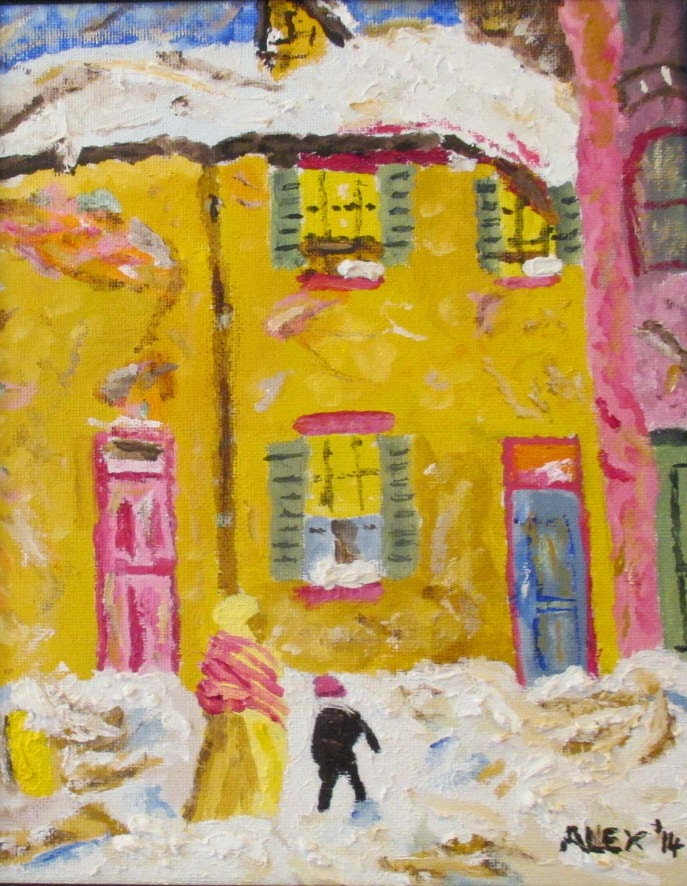
As an artist, I am very inspired by the group of members that participate in the art program. Most have never painted before, some have had to learn to use their non-dominant hand as a result of stroke, and all have aphasia in varying degrees. Alex, one of our members,in spite of language difficulty and some physical deficit,  has found a new way of expression in photography and now painting. 


Making art is such a wonderful way to communicate when the right words may fail you!  I admire the energy and fearlessness of Alex  as he finds new pathways to enjoy life. As you can see from the paintings, his talent is also to be admired.

Thank you to Alex for sharing his work with all of us. For more information about the Aphasia Institute go to www.aphasia.ca


Visit  My Website

Friday, August 15, 2014

Limited Palette Plus

Of course limited palettes can be boring after some time, especially for the artist. It is fairly easy to continue bu adding just a touch of something new as in the two paintings below, both done on yupo with acrylic paint.

Coastal Colours

"Coastal Colours" utilizes quinacridone burnt orange, anthraquinone blue and zinc white, but also quite a shot of relief from cadmium yellow in the sky.

Last Leaves

Tiny surprises of cadmium red adds interest and contrast and directs the eye to the "last leaves".

Both paintings were "imaginary" - my latest mode.

Go to my Website


Sunday, August 10, 2014

How limited Can a Palette Be?

How limited?? 

A palette can be limited to one colour as in the Haliburton painting below, which utilizes black is diluted with water to produce a range of values.

Haliburton Inlet

This can be exciting, but also can be ultimately boring for those of us that love colour. In the last series of paintings, I used two basic colours plus white. I did add a tiny amount of hansa yellow in one or two paintings. I  want to show, in a very crude fashion what can be achieved by limiting the palette to quinacridone burnt orange, anthraquinone blue and zinc white. The base colours are the top two on the left column. I have done nine paintings utilizing basically these two colours.


Another basic palette could include: - Alizarin crimson, - Ultramarine Blue - Cadmium yellow light
- White OR for watercolour: - Raw Sienna,  - Burnt Sienna - Ultramarine blue


There is much to be gained by limiting your  palette:
- economy by purchasing less paint
- colour harmony in the painting
- less chance of creating "mud"
- encourages more attention to values
- easier to pack.

Of course with all limited palettes, at the end of a painting it can add excitement to introduce a small touch of unexpected contrasting colour as a bit of visual eye candy eg. a bright orange leaf in a predominantly cool painting.

Anders Zorn 1860 - 1920 was a Swedish artist. He is best known for his portraits, domestic scenes and nudes in outdoor settings.


Of interest, however, is his reputation for using a palette limited to to only four colours - yellow ochre, cadmium red medium, ivory black and white. A much better representation than mine, of the myriad of colour produced by a few colours is the Zorn palette below.


Go to My WebSite

Monday, July 21, 2014

Limited Palette Part Three

This is the continuation of my project to restrict myself to a limited palette. This is the third in the group - and probably the last ( I think that I said that before). I used quinacridone burnt orange, anthraquinone blue, white, and a mere suggestion of  cadmium yellow medium.  This group continues the Papamoa tree theme which is inspired by Papamoa Beach, New Zealand, which is near the home of my daughter.
I have learned a great deal by  using a limited palette. In my next post, I will try to share the colour and value variations that can be achieved.

Papamoa #2

Papamoa #5

Papamoa #4

Go To My WebSite

Monday, April 21, 2014

A Great Art Opportunity


Time to celebrate the end of this long winter and to enjoy some great art from local artists in the North York area.
I am again part of the North Toronto Group of Artists Spring Studio Tour on Saturday May3 and Sunday May 4 from 11.00 – 5.00. It is a free  self-guided tour of eighteen artist’s homes and studios. You can browse, chat, have some light refreshments and maybe purchase a piece of original art. I will be exhibiting watercolours and acrylics at 109 Old Orchard Grove and look forward to seeing you there. 

Go to the North Toronto Group of Artists website  www.ntga.ca to view a larger brochure with  information about the artists and a map. Brochures will also be available at all artist's studios.

Anne Neidhardt
416 480 2248


Go Back to My Site

Monday, April 7, 2014

Hard to Beat This

Sometimes it is hard to improve on nature!


Sometimes beautiful landscapes are like cliches.


These photos are from a recent trip to NewZealand and the some of the islands in the South Pacific -  no lack of inspiration there, but where to begin? I do also have lots of "cow" photos. I could begin there. Stay tuned.


Go  to My WebSite

Monday, February 24, 2014

Paintings too bad to throw away

Sometimes there are embarrassing paintings - impossible to leave in the garbage, identified as yours!
There are options:

- if on canvas then good old gesso cures all ills
- if paper and watercolour, then a dunk in a sink might remove most if not all and the process can begin again
- if paper and acrylic, good old gesso can come to save the day again or even gesso over watercolour to scrape out colours and images
- if paper, interesting pieces can cut out for a later collage
- if paper, the painting can be cropped to leave a smaller but more interesting composition
- of course, yupo and terraskin allow more flexibility in removing an wiping out images.

This painting is a good example of a rescue of a painting gone wrong. This is acrylic on terraskin, and renovated with the inspiration of a very good teacher, D.D. Gadjanski. See her work at www.ddgadjanski.com/‎  and on YouTube at www.youtube.com/user/DDGadjanski


Lonely Beach


The lightbulb series continued


How many modern artists does it take to change a light bulb?
Four. One to throw bulbs against the wall, one to pile hundreds of them in a heap and spray-paint it orange, one to glue light bulbs to a cocker spaniel, and one to put a bulb in the socket and fill the room with light while all the critics and buyers are watching the fellow smashing the bulbs against the wall, the fellow with the spray-gun, and the cocker spaniel.

Go  to My WebSite